
Two Popular, Low-Maintenance Choices
If you’ve narrowed your search down to aluminum and vinyl, you’re already ahead: both are far lower-maintenance than wood, and both hold up well over time. But they’re genuinely different products suited to different goals, and the right choice comes down to what you actually want your fence to do for your yard.
Appearance and Style
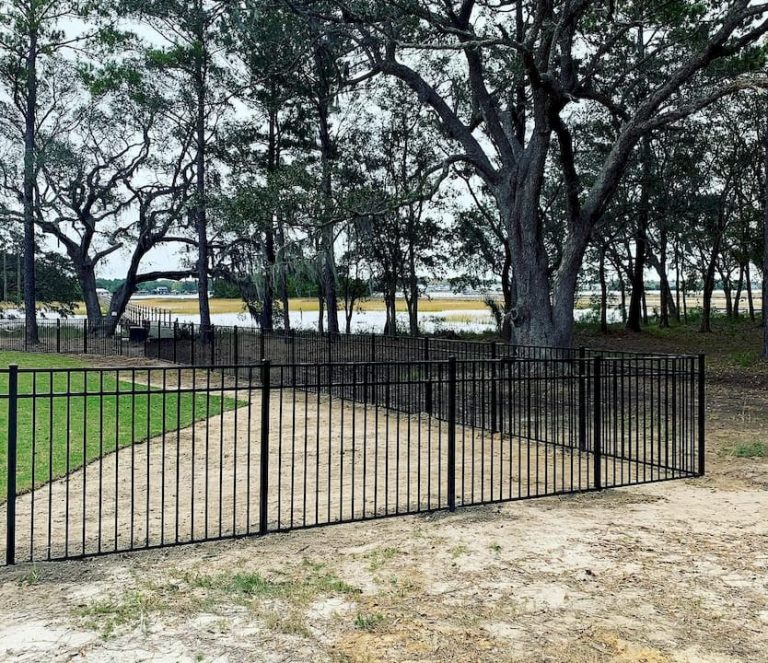
Aluminum fencing has an open, ornamental look: narrow vertical pickets, decorative tops, and a finish (usually black) that reads as upscale and traditional. You can see the yard through it, and it tends to complement brick and stone exteriors especially well. Our full range of aluminum fencing styles shows the variety available, and our post on black aluminum fencing covers why it’s become such a popular Charlotte look.
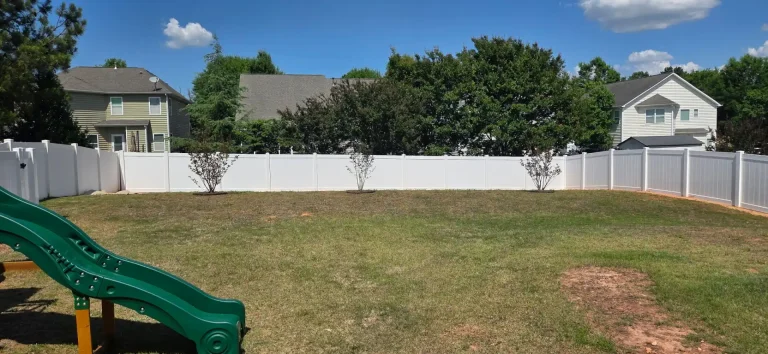
Vinyl fencing looks completely different: solid panels in white, tan, or a wood-look finish, built for a clean, uniform appearance from post to post. It’s a more contemporary, buttoned-up look, and it comes in styles from fully solid to semi-private with some spacing between boards. Both materials show up throughout Charlotte, and it’s more about style than it is about quality. Our decorative fencing page shows how each material fits into different design directions.
Privacy and Sightlines
This is usually the deciding factor. Vinyl fencing, especially in its solid panel styles, creates a real visual barrier: you can’t see through it, and neither can anyone walking or driving past. If privacy and screening are the main goal, vinyl (or a solid wood fence) is the more direct answer.
Aluminum is the opposite by design. It’s an open, ornamental fence, not a privacy product: For the most part, you’ll see straight through it, and so will everyone else. That’s a feature for homeowners who want a defined boundary without blocking their view of the yard, landscaping, or pool. There are privacy solutions that can be incorporated alongside aluminum fencing to give you the best of both worlds. For homeowners weighing that trade-off, our privacy fencing page covers the options built specifically for that purpose.
Maintenance
Both materials are low-maintenance compared to wood, but they earn that reputation differently. Vinyl does not need painting or staining. Aluminum’s powder-coat finish is designed to hold its color without refinishing. Routine cleaning is generally the main upkeep for either material.
Durability and Lifespan
Vinyl is engineered to resist cracking and fading, while aluminum provides a rigid metal profile that holds its shape without warping or sagging. Both materials are selected for long-term residential use, but they create very different fence lines: vinyl uses panels, while aluminum uses an open ornamental picket design.
Typical Cost
Wood and aluminum tend to land in a comparable price range, closer to each other than either one is to vinyl. Vinyl typically carries the higher price tag of the three, largely because a solid panel system uses significantly more material per linear foot than an open picket design.
That gap is worth thinking through if privacy is part of what you’re after. Vinyl earns its higher cost by giving you a solid, private enclosure right out of the box. Aluminum doesn’t, it’s an open, ornamental fence by design, not a privacy product. But because aluminum typically costs meaningfully less than vinyl, some Charlotte homeowners put that difference toward landscaping, shrubs or hedges along the fence line, to build in the privacy themselves while keeping aluminum’s ornamental look and low upkeep. It’s one way to land both goals: the style you want and the privacy you’re after, without paying vinyl’s premium to get there.
Either way, think of the fence as a long-term investment rather than a line-item expense. The right call comes down to whether privacy or an open, ornamental look matters more for your yard, not just the upfront number.
Which One Fits Your Charlotte Yard?
If your priority is a screened, private backyard, vinyl is the better-suited material. If you want a fence that defines your property line, complements your home’s exterior, and keeps sightlines open to your landscaping or pool, aluminum is the stronger fit. Some properties use vinyl where screening is needed and aluminum where open views and ornamental style matter. If you’re also considering wood as a third option, our aluminum vs. wood fencing comparison is a good next read.
Get Expert Guidance Choosing Between Aluminum and Vinyl
Every yard is different, and the right material usually comes down to a quick walk-through of your property and what you’re trying to accomplish. Get a free estimate and we’ll help you compare aluminum and vinyl side by side for your specific home, or browse more fencing comparisons on the blog.
Free Estimate
No deposit required. We respond within 24 hours.